The following is the full article quoted from _The Falmouth Enterprise_ published on 7/17/26 pages 1 & 13, entitled, “Residents Weigh In On Outfall Proposal”.
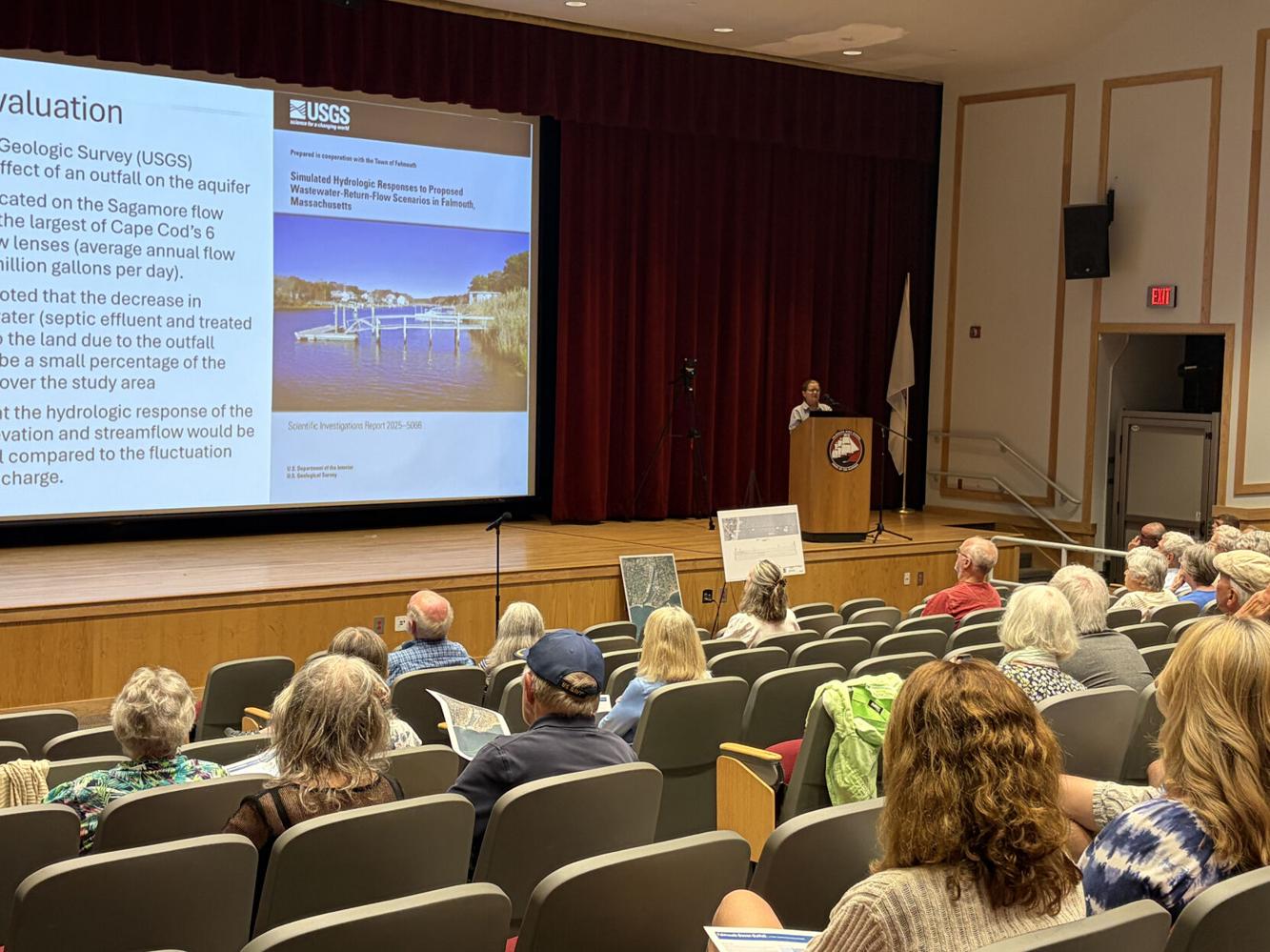 About 30 residents convened at Falmouth High School to learn about the proposed outfall, share their comments and express concerns. LIN LIN HUTCHINSON/ENTERPRISE
Residents voiced support, skepticism and a range of environmental concerns during a public meeting on the town’s proposed offshore wastewater outfall, using the forum to comment on the project’s Draft Environmental Impact Report before the state review process moves forward.
The meeting, hosted by the town’s wastewater division, gave residents an opportunity to ask questions and provide feedback on the draft report, which was filed with the Massachusetts Environmental Policy Act (MEPA) office on June 30.
While comments made during the meeting were part of the general public discussion, formal comments on the report must be submitted in writing by August 21 to be included in the state’s review.
The proposed project would install a six-mile pipeline from the town’s Wastewater Treatment Facility to an offshore discharge point about 2,300 feet into Nantucket Sound. The pipe would extend from Kite Park in Falmouth Heights out into the sound.
The outfall is part of the town’s effort to expand sewer service and reduce nitrogen flowing from septic systems into nitrogen-impaired estuaries.
The system is being designed for an average flow capacity of 3 million gallons per day, though the initial discharge would begin at no more than 710,000 gallons per day.
The pipes would be installed using horizontal drilling. Under roads and the beach, the pipe would be installed more than 35 feet below ground, with the deepest sections reaching approximately 100 feet.
The environmental report, which Wastewater Superintendent Amy A. Lowell presented to the Select Board last month, concluded that outflow from the pipe would have no significant adverse impacts on water quality or marine habitat in the sound. The findings are based on more than two years of environmental monitoring, hydrodynamic modeling, aquifer studies and marine habitat surveys conducted in coordination with state and federal agencies.
Lowell said wastewater would receive tertiary treatment and ultraviolet disinfection before being discharged through a diffuser system designed to rapidly mix the treated effluent with surrounding seawater. Modeling found that the strong east-west tidal currents in Nantucket Sound would dilute the discharge by about 1,000 to 1 within a few hundred feet of the outfall.
The project would not significantly affect groundwater, eelgrass beds, shellfish or fisheries, while an antidegradation analysis found the discharge would not degrade surface water quality.
The report concluded the project would provide an overall environmental benefit by allowing the town to expand sewer service and reduce nitrogen flowing from septic systems into coastal ponds.
Alternatives To Sewering
Questions and concerns remained among some of the 30 or so residents who attended the meeting.
Earle Barnhart, co-director of The Green Center, said the 47 tons of nitrogen treated by the outfall would be “wasted.”
For housing, “There are approved alternatives that recover and recycle 47 tons of nitrogen,” Barnhart said.
He suggested the nitrogen could be collected and repurposed by farmers to grow food in a sustainable way. Barnhart has been an advocate of urine diversion, an alternative to traditional sewering.
Lowell said not all of town would be sewered, with only about half of Falmouth likely to receive sewer service. The remaining properties could leave opportunities for alternatives such as urine diversion, if and when the state approves those methods.
“It can not replace sewers at the scale at which nitrogen removal is required to meet the nitrogen limits,” Lowell said about urine diversion.
When asked about future modifications to the system, Lowell said the town has included funding in its estimated $80 million construction budget for potential treatment plant upgrades.
During the meeting, Lowell and Ed Jalowiec, chairman of the Water Quality Management Committee, also addressed questions about regional wastewater efforts. They said Falmouth’s geography differs from other Cape Cod communities and limits available alternatives.
Jalowiec said no other Cape town is currently pursuing a similar offshore outfall because many have land available for wastewater recharge, while Falmouth’s numerous nitrogen-sensitive watersheds leave few viable options.
Lowell said there is nowhere to discharge without “chasing your tail.” While regionalization may be “appealing,” Lowell said it is “extraordinarily complicated,” requiring coordination with additional agencies, inter-municipal government and resident input.
Climate Change Impact Cited
Climate change impacts were also a concern raised by residents.
Hilde Maingay, the other co-director at The Green Center, expressed concerns about nitrous oxide as a byproduct of the outfall and questioned its potential impact on climate change.
Lowell said the level of nitrous oxide is “a very small percentage” of nitrogen released into the air and is “not a main byproduct.”
Maingay also raised concerns about pharmaceuticals, PFAS (forever chemicals) and microplastics that would not be treated by the outfall system.
“We are not making the situation worse…by bringing that wastewater to the wastewater treatment facility,” Lowell said in response, emphasizing that the state has set a mandate for the town to address its nitrogen load.
She added that the current treatment system does not remove the contaminants Maingay identified, though “centralizing wastewater treatment does give you the opportunity to remove things in the future if that’s required.”
Lyn Schad questioned how the town would respond if a catastrophic equipment failure occurred.
“That same question applies now as it would in the future with an outfall,” Lowell said, explaining that multiple monitoring and backup systems would remain in place, including existing groundwater discharge facilities that could be used in emergencies.
As for the cost of the project, the design for the outfall is estimated at $7 million. The appropriation is scheduled to be presented at the April 2027 Town Meeting, with a debt exclusion ballot question expected at the May 2027 election. The estimated tax impact is between $16 and $24 per year on a median single-family home.
The tax impact of the estimated $80 million construction cost is not yet fully understood. It will depend on several factors, including whether the town adopts a Water Infrastructure Investment Fund and whether the town receives a state 0% interest funding commitment and Cape and Island Water Protection Fund loan forgiveness.
The draft report and instructions for submitting written comments to the state’s online public comment portal, by email or by mail can be found on the town’s website. Comments will be accepted until August 21.