The following is the full article quoted from The Falmouth Enterprise published on Friday. 7/3/26, pages 1 & 13, entitled, “Town Honors 1779 Battle With New Monument” (online as “Falmouth Dedicates Monument To Revolutionary Defenders During 250th Celebration”).
“Ordinary people doing extraordinary things.”
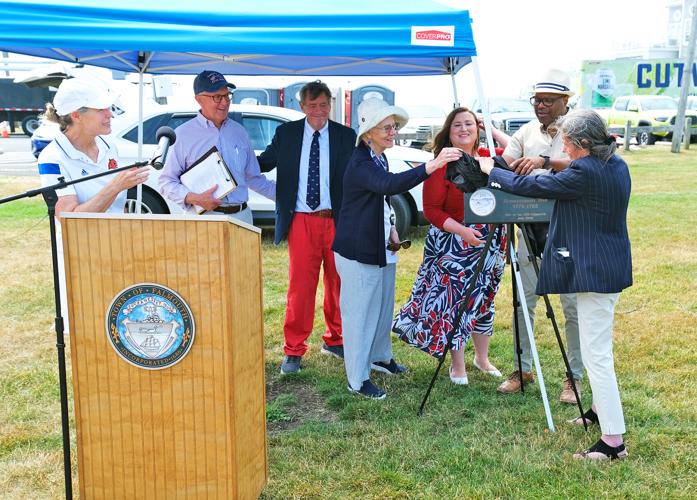
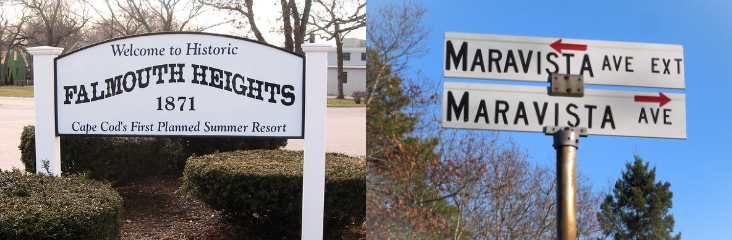
That message echoed repeatedly Wednesday morning, July 1, as residents, elected officials and historians gathered in Falmouth Heights to dedicate a new monument commemorating the 1779 Battle of Falmouth, a Revolutionary War conflict that speakers said was won by ordinary residents who stepped forward when their community needed them.
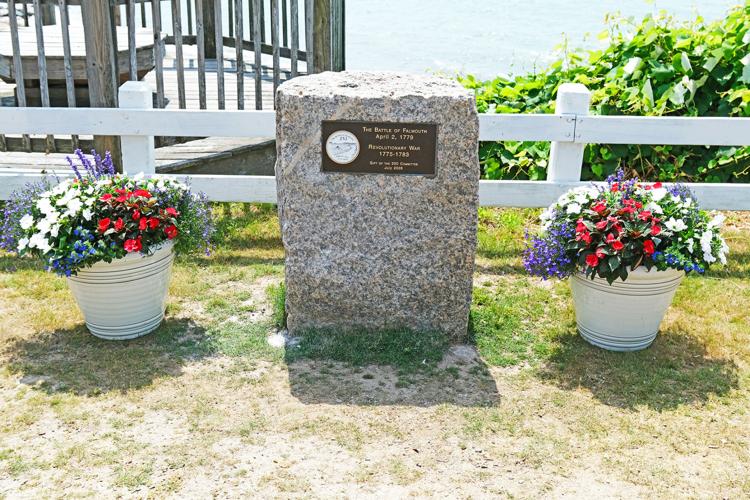
The ceremony was part of the town’s participation in the nation’s 250th anniversary celebration. At the event, officials unveiled a pink granite monument and plaque overlooking Vineyard Sound near the site where British forces attempted to land in April 1779.
Town Manager Michael Renshaw said the victory belonged to “farmers, fishermen, tradesmen, physicians and neighbors” who believed in “determination, preparation and an unwavering belief that their homes and liberties were worth defending.”
“The preservation of freedom is always, and will always, depend upon ordinary people’s willingness to do very extraordinary things,” he said.
According to local historians, British plans to burn Falmouth were overheard by John Slocum, a resident of Pasque Island believed to have been sympathetic to the Crown. Setting politics aside, Slocum sent his young son—believed to have been 10-year-old William Slocum—to row across the water under cover of darkness and warn the town.
“That boy became a man in just a few minutes,” artist and historian Karen Rinaldo said. “He also became Falmouth’s Paul Revere.”
His warning gave Major Joseph Dimmick and approximately 220 local militia members time to reinforce earthworks along what is now Surf Drive. When British forces attempted to come ashore the following morning, the militia drove them back. Falmouth was the only Cape town to successfully repel a British landing during the Revolutionary War.
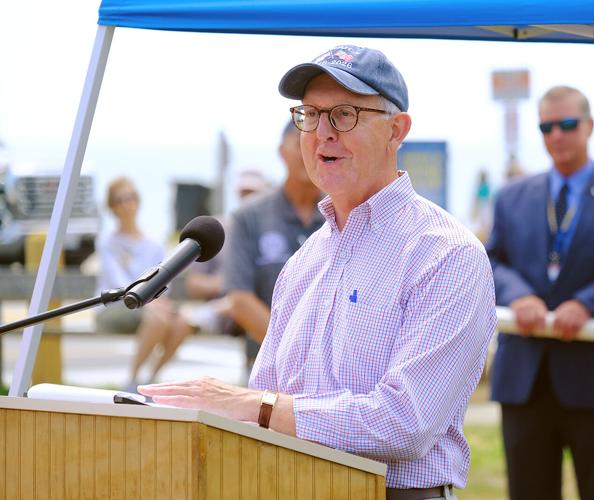
Keynote speaker and historian David S. Martin described the militia not as professional soldiers, but as neighbors who left their farms, workshops and fishing boats when the alarm sounded.
“They were ordinary people, like you and me,” Martin said. “They stepped forward, preserved independence and left us liberties that we still enjoy today.”
Martin shared the story of his own fourth-great-grandfather, Abraham Swift, a 16-year-old fifer in the Falmouth militia whose role was to relay battlefield commands through music. Though he never carried a musket, Martin said his ancestor answered the call alongside hundreds of others whose names rarely appear in history books.
Speakers said that same spirit continues to define Falmouth today.
Falmouth Chamber of Commerce Executive Director Michael Kasparian traced the town’s evolution from an agricultural and fishing community to one known for tourism, science and civic engagement, saying residents still come together to support one another and their community.
“In the spirit of the Battle of Falmouth, that’s still going on today,” he said.
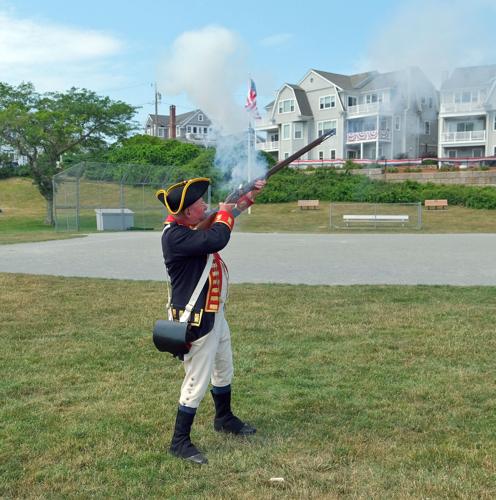
Throughout the hour-long ceremony, prayers, patriotic music, proclamations and historical reflections connected the sacrifices of 1779 with the responsibilities of the present.
State Representative Thomas W. Moakley (D-Barnstable, Dukes and Nantucket) reminded attendees that preserving democracy depends on each generation’s willingness to participate in civic life. He invoked Abraham Lincoln’s 1838 address to the Young Men’s Lyceum of Springfield, in which Lincoln warned that the greatest threats to the republic would not come from abroad, but from within.
“I find those words to be a reminder that the promise of the Declaration and of the Constitution, while self-evident, is not self-fulfilling,” Moakley said. “It requires us to show up. It requires us to participate. It requires us to make room for ideas that differ from our own and find a way to reconcile them as neighbors, so that the Republic endures peacefully for another 250 years.”
The monument itself is a hand-selected piece of pink West Falmouth granite. It stands atop Great Hill in Falmouth Heights overlooking Vineyard Sound, facing the waters where British ships had assembled for the battle. The accompanying plaque, illustrated by Rinaldo, depicts a lone boy rowing toward Falmouth, honoring the warning that helped save the town.
The event was organized by the town-appointed 250th Anniversary Task Force. The task force has also been working to plant a liberty tree as another tribute to America’s 250th anniversary.