For your interest, the following is the full content from The Falmouth Enterprise article published on 3/27/26, page 3, entitled, “Proposal Would Rename Little Pond Area To Honor Longtime Town Conservation Leader.”
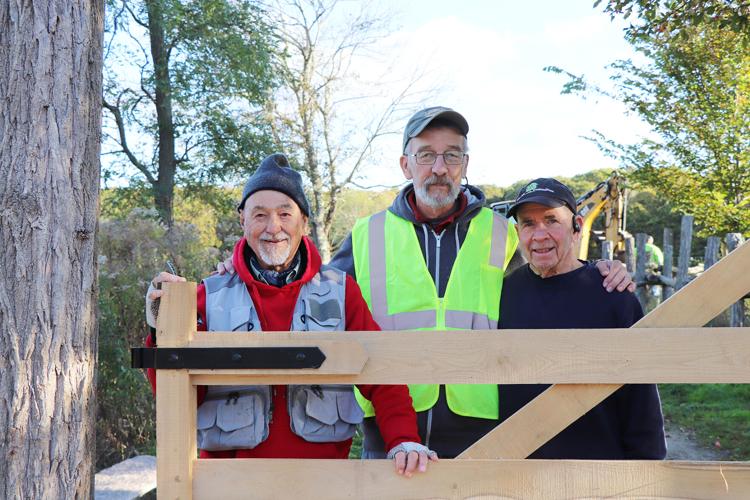
The Little Pond Conservation Area could be renamed the “Mark Kasprzyk Preserve” in about a year under a proposal to honor longtime town conservation employee Mark J. Kasprzyk for his role in restoring the site.
Kasprzyk retired in November 2025 after nearly three decades of service to the town. Over the course of his career, he served as a conservation agent before later working as a land manager and a Marine and Environmental Services technician.
During this week’s Select Board meeting, Jessica Whitenour, executive director of The 300 Committee Land Trust, and Jennifer Lincoln, the town’s conservation commission administrator, said Kasprzyk played a key role in restoring and improving the Little Pond Conservation Area. His work helped transform the property into a space that supports both conservation efforts and public access.
The conservation area consists of a 10-acre parcel off Spring Bars Road, adjacent to the 11-acre Little Pond Place Apartments developed by the Falmouth Housing Corporation. The combined 21-acre property was acquired through a partnership of community organizations and town funding, including support from the Teaticket Civic Association, the Save Little Pond organization, the Community Preservation Committee and Town Meeting.
When the land was first acquired in 2010, it required significant restoration before it could be opened for conservation and public use, Whitenour said. Progress accelerated, however, after Kasprzyk took over the project while working in the conservation department.
“There was no turning back once Mark was appointed as the project manager. The ‘on-the-ground’ progress for the actual restoration needs of the site really started to take off. The site work was visible and meaningful,” Whitenour said. “His oversight for this project laid the groundwork for success, habitat restoration and public access improvements.”
Lincoln added that Kasprzyk’s leadership and management were critical to completing the project efficiently while also saving the town money.
“He spent countless hours going over materials lists, plant lists and plant counts out in the field,” Lincoln said. “He did a lot of the project oversight himself, saving the town thousands and thousands of dollars.”
The Little Pond Conservation Area officially opened to the public on June 24, 2025, after years of planning and cleanup.
Before its restoration, the site had been used as a dumping ground for a former concrete and building company. It was filled with invasive plants, trash, and other debris—totaling 100 tons, according to the Department of Public Works.
The town purchased the 21-acre property in 2010 for $3 million after plans for a 168-unit Chapter 40B housing development fell through. Four acres were later developed into 40 affordable apartments by the Falmouth Housing Corporation, while the remaining land was restored as conservation space.
The naming request was jointly submitted to the Select Board by The 300 Committee Land Trust and the Conservation Commission.
Additional support for the proposal came from the Teaticket Civic Association.
In a letter submitted to the town, association co-president Mary Little wrote that the group “strongly reiterates its support” for the proposal, praising Kasprzyk’s long-standing commitment to protecting the town’s environment.
“This town should be proud of Mark, whose sole job in the last 27 years was to selflessly preserve and enhance the wildlife and environment of this town,” Little wrote.
Under the town’s naming policy, initial approval by the Select Board would trigger a one-year waiting period. During that time, a designated reviewer would research the proposal and return to the board with a recommendation before a final decision on the name is made.