FHMNA Note: The link to the Town Draft of the Plan is at the bottom of the article. If you were unable to attend but have some comments, please direct them to The Beach Committee (beachcommittee@falmouthma.gov) with a copy to the Town Manager, (townmanager@falmouthma.gov) and include your name and Falmouth address.
A public meeting held this week to review the town’s draft Beach Management Plan drew a modest crowd, consisting primarily of town officials, members of the Beach Committee, one select board member and 10 residents.
The meeting, hosted by the town in coordination with consulting firms Urban Harbor Institute (UHI) and Geosyntec, offered residents the opportunity to ask questions and provide feedback on the plan, which outlines protocols for beach operations, coastal resilience and infrastructure management, among other recommendations.
Shannon Hogan, research associate for UHI, provided an overview of the draft plan.
Hogan emphasized that Falmouth beaches are “dynamic” as sand is constantly moving due to wind and waves, resulting in ongoing erosion and accretion at different beaches.
She also outlined operational protocols for pre-season, in-season and post-season maintenance, including suggestions for lifeguard staffing, dune restoration, beach nourishment and management of beach facilities and signage.
About an hour before the public forum on Tuesday, the Beach Committee, during its monthly meeting, had the opportunity to provide UHI and Geosyntec representatives with initial feedback.
Chairwoman Barbara P. Schneider highlighted concerns with the plan’s opening sentence, suggesting the introduction should prioritize the role of beaches in protecting town infrastructure and private property over aesthetic or recreational value.
The committee also recommended that key sections, including recommendations and beach profiles, be paired together and placed at the front of the document, making the plan more of a “user manual” for coastal officials, with charts and methodology placed later in the document. The document would be utilized by the town to determine future beach management projects and progress checks toward meeting the recommendations.
Along the lines of prioritization, vice chairman Joseph Strazzulla suggested that recommendations be put in the ranking of priority, as they currently are not.
Other committee members pushed back on UHI’s description of certain beaches like Surf Drive and Old Silver Beach as “mostly stable” beaches, despite erosion during storms and numerous nourishment efforts. The group agreed to describe the beaches as “dynamic.”
During the main public meeting on the plan, resident Arthur Q. Gutch of Terry Lou Avenue voiced his desire for a minimalistic feel of the beaches and urged that signage remain simple and development at beaches, like any future expansion to parking lots, be kept to a minimum.
North Falmouth resident Alison Ferrante expressed disappointment that the plan does not address the significant sand accretion at Megansett Beach. Ferrante said residents from Bourne and Falmouth have worked for years on potential dredging, which could provide nearly 17,000 cubic yards of sand for beach nourishment. She warns that, without action, the area could turn into a marsh.
Select Board vice chairwoman Heather M.H. Goldstone was in attendance and clarified the report’s description of the Beach Committee’s advisory role, noting it advises the Select Board, not the Beach Department, and recommended explaining the interaction between the management plan and town policy-making strategy and process.
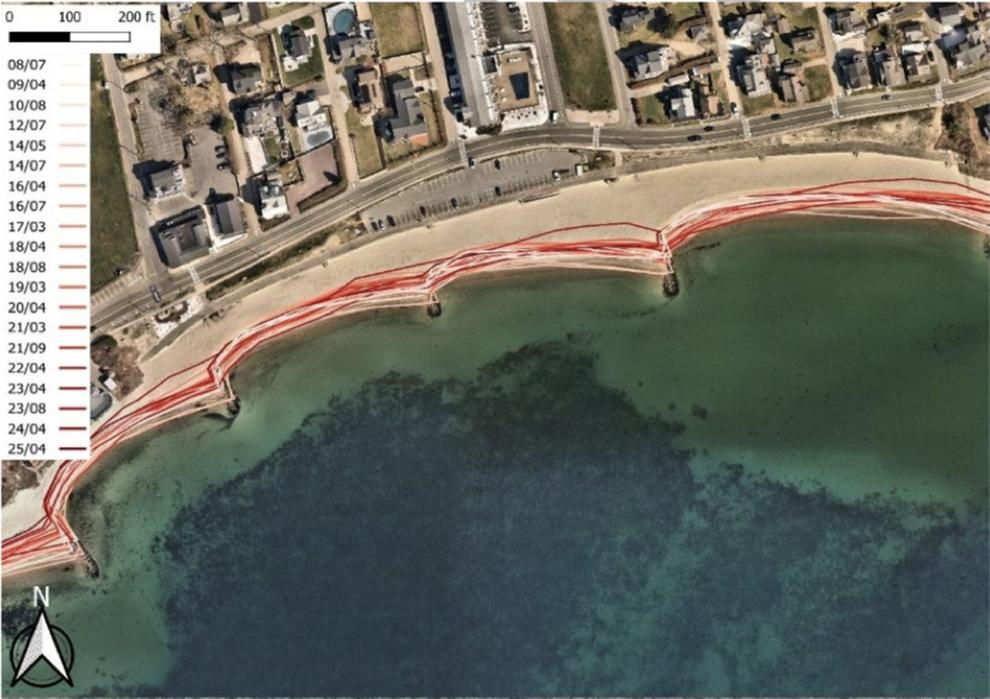
During her presentation, Hogan provided a brief overview of shoreline conditions.
Beach Erosion Rates Specified
Old Silver Beach continues to erode at a rate of one to two feet per year.
At Surf Drive, shoreline accretion of approximately 2.5 feet per year is occurring, largely due to frequent beach nourishment using dredged material.
The unprotected portion of Chapoquoit Beach is eroding at roughly two feet per year, she said. Wood Neck Beach remains net stable, with Hogan noting that the northern inlet is armored, limiting sand migration, while the southern inlet bank remains unarmored and more dynamic.
At Falmouth Heights, the presence of a seawall has resulted in no significant erosion or sand buildup. Bristol Beach shows mixed conditions: the shoreline west of the inlet is retreating at about 1.5 feet per year, while the area east of the inlet is experiencing slight accretion of less than one foot per year. Dunes at Bristol have increased in height since 2018.
Menauhant Beach (both the east and west ends) continues to receive nourishment. The west side has a low dune crest and is becoming increasingly vulnerable to storm surge, while the east side is seeing modest sand buildup due to longshore sediment transport.
Among the 33 recommendations, continued dune restoration, beach management and utilization of dredging were among key action items in the category of coastal resilience. For planning, preparedness and storm response, the draft plan calls for developing pre- and post-storm response plans and establishing a record-keeping system for beach and dune restoration, inlet dredging and storm damage.
Beach operation and management recommendations include: review the beach management plan every five years; increase staffing; develop and formalize shark sighting and marine mammal disposal protocols; and enhance communication among town staff and departments.
Hogan also said the town should develop plans to eliminate direct discharge of storm water and surface runoff from parking lots onto beaches and conduct surveys of waterfront engineering structures at public beaches.
A draft of the plan can be found on the town’s website.